In the space sector, we work directly with and against ‘our’ sun; it dictates all space operations and trials
Our meeting with Frédéric Marin, CEO of USIL SA, is a bond of trust that continues to grow stronger, step by step.
A little background: behind every discovery of an innovative product, there is already a whole story!
FA2M SRL (Belgium) is a company that hosts an international network of researchers in the medical field, focusing primarily on orphan diseases. As early as 2013, researchers in France had taken an interest in an old Benelux molecule (discovered around 1890) which potentially exhibited specific properties in a nuclear environment; it had subsequently attracted particular attention, as its properties raised hopes of encouraging results in the treatment of conditions associated with acute radiation syndrome (or ‘radiation sickness’);
These occur following a single exposure to a high dose of ionising radiation. However, a lack of additional resources (coupled with a certain degree of fatigue), on the one hand, and the COVID-19 pandemic, on the other, had taken their toll, thereby halting all further development of the molecule.
The key: space technology transfer involves analysing, understanding and transforming a need into a concrete demand, whilst providing the space-based solution!
A transfer is also all about the connection! In late 2023, when Créaction met the director of FA2M (Frédéric Marin), he spoke of space as a dream, a Tintin story, a ‘Moon landing’… He could see a potential application for his molecule in the adventure of space exploration, but didn’t dare to believe in it, let alone talk about it. Rather than discouraging him, Créaction – buoyed by four successful demonstrators in the field of land-based nuclear transport safety (non-space to space technology transfers) – invited him to a day of presentations and workshops to assess the results that had been put on hold; several meetings and discussions were needed to identify the current state of research and the steps and investments still required.
On the basis of this initial positive assessment and further research into the overall positioning, Créaction proposed taking up the challenge and utilising space technology transfer to ‘break the deadlock’ and demonstrate the validity of this molecule as a future medicine or pharmaceutical solution. The process of obtaining marketing authorisation for a medicinal product involves three stages; two of these had already been completed, as, prior to any human trials, the candidate molecule is studied in the laboratory (in vitro) and in animals (in vivo) to assess its toxicity, pharmacokinetics (absorption, distribution, metabolism, elimination) and biological efficacy. Only molecules that are sufficiently promising and safe make it through to the next stage – and we’d made it! All that remained was the clinical trial phase, which is no mean feat!
Where cosmic radiation is at its highest, in microgravity!
The space sector could significantly accelerate the testing process if we turned to microgravity trials. Why? Well, because in the space sector, we work directly with and against ‘our’ sun; it dictates all space operations and trials. Unlike life on Earth, we have no protection; we are constantly forced to protect ourselves. In fact, we are the children of the sun, and without the sun there is no life – yet, paradoxically, we must beware of its harmful ionising rays!
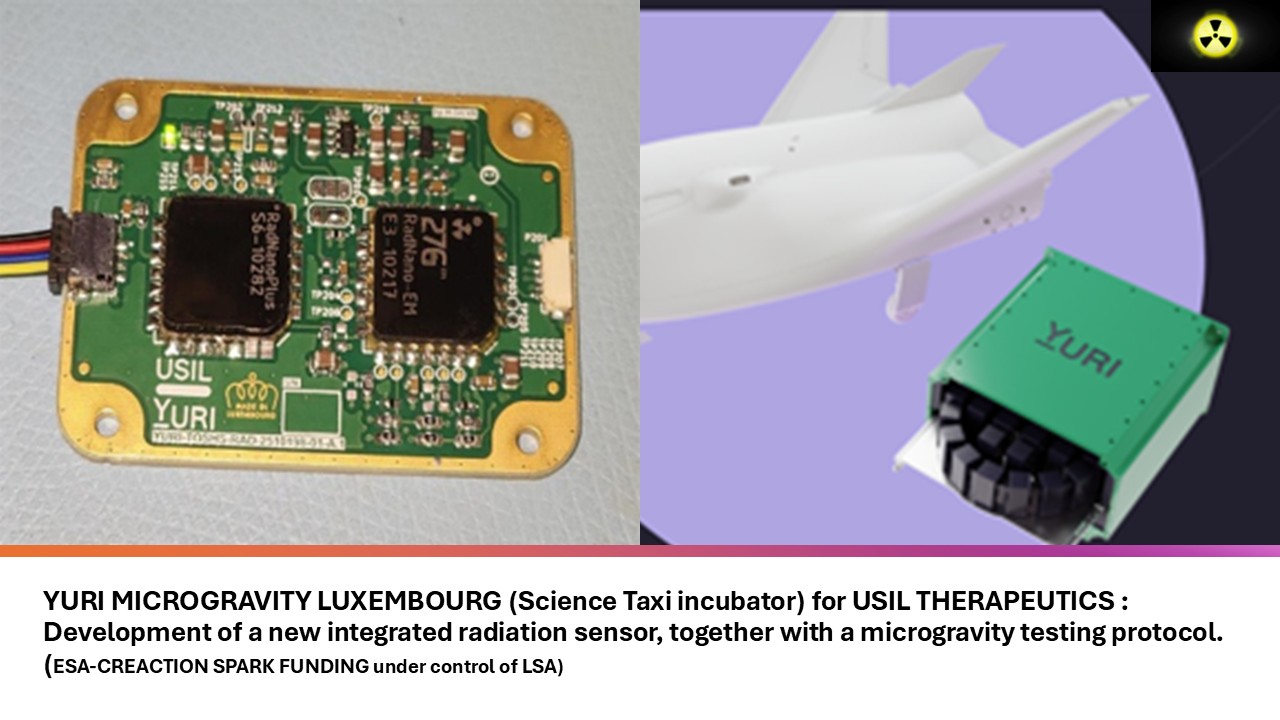
This is where the Luxembourg-based company YURI GRAVITY comes in. It creates microgravity testing solutions and is the developer and manufacturer of a new space laboratory, largely funded by the Luxembourg Space Agency; the ‘space lab’ takes the form of a small case containing all the centrifuges and other microsystems required for in-flight testing and validation. To tailor the offering to demand – that is, to develop and integrate a radiation microsensor system into the case to enable continuous measurements – an application for support from the ESA SPARK FUNDING scheme (financial aid for technology transfer) was submitted and swiftly approved for a programme with a development timeframe of 6–8 months.
Today, the integrated radiometric sensor solution is itself a technology to be transferred to other space and non-space applications. And the test protocols developed as part of the same work programme are ready. The ball is now in YURI’s court.