And isn’t it said that without dreams, there would be no ideas, and that without ideas, there are no concepts?
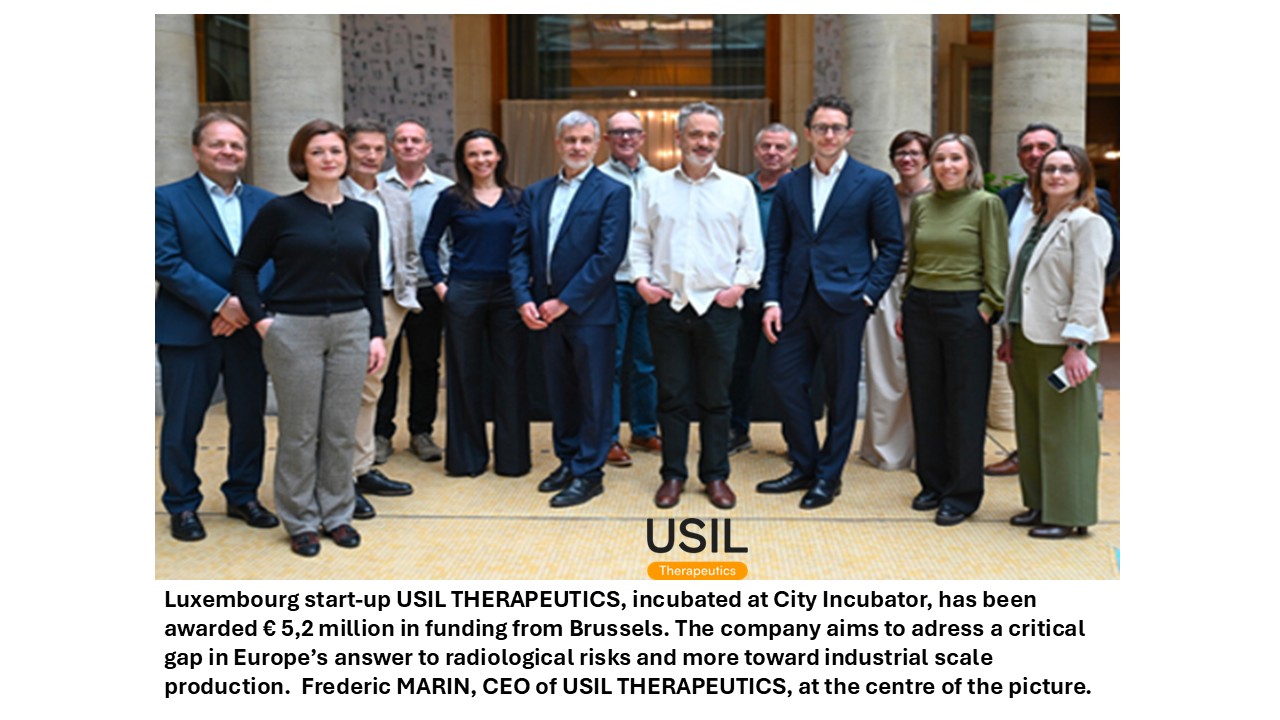
Indeed, at the same time, spurred on by this momentum, Frédéric Marin, together with his initial shareholders, founded USIL SA in Luxembourg in October 2025: the company’s purpose is to develop anti-radiation drug solutions. In the same vein, a major research project was submitted to and selected by the European Commission; it has been described as strategic for Europe and has been awarded substantial funding (5.3 million euros out of a total project budget of 8 million euros) to complete the research, including demonstration and approval by the EMA (European Medicines Agency).
A small initiative (the transfer of space technology) with major implications! All the more so as the European Astronaut Centre (EAC) of the European Space Agency, following the Spark Funding, has begun to explore this opportunity as a proven safety solution for the future of space exploration: to this end, USIL, with the support of Créaction, will submit a proposal in the coming months for an R&D programme focusing on pre-diagnostic and diagnostic monitoring of astronauts, based on the validated effects of the new molecule. An application for financial support will be submitted to the LSA for space-related research, as astronauts are exposed to far greater risks than we are here on Earth.
Who will this future medicine be aimed at? Answer: all of us
But actually, how does this future medicine work? Well, surprising as it may seem, when faced with the effects of radiation on cells, it promotes the repair of double-strand breaks in DNA whilst blocking the production of free radicals. The AOL molecule is designed for a dual purpose: the prevention and protection of people in their working and living environments.
And we’re back to the issue of transfer: today, none of the medicines on the market ‘cure’ radiation exposure; they either prevent or reduce the absorption of radionuclides, or help the body to recover. The only exception is potassium iodide (stable iodine tablets distributed by health authorities in emergencies). With USIL, the future commercial product will be aimed at everyone, but primarily at staff at civilian facilities such as power stations, hospitals specialising in radionuclide medicine, or astronauts on space stations such as the International Space Station (ISS).
Starting with a dream isn’t as crazy as one might think at first glance!
There are some encounters that are not mere coincidences; a combination of circumstances, facts and the tools to respond to them are very often there to help make one’s dreams and projects a reality, and the Centre can play a significant role in bringing them to fruition. Indeed, a project could not have succeeded without a convincing demonstration – whether based on technological feasibility or laboratory-scale testing – which itself stemmed from a validated concept… And isn’t it said that without dreams, there would be no ideas, and that without ideas, there are no concepts?
What Frédéric Marin has always dreamt of, what he has always strived for, and what his teams are putting in place today – all of this is the result of a long journey, perseverance and countless encounters.